Where Does Morality Come From?
A review of Jonathan Haidt's book The Righteous Mind
This article reviews Jonathan Haidt's book The Righteous Mind, focusing on the question of morality's origins rather than the book's primary thesis about political division.
The Nature vs. Nurture Debate
Haidt examines two traditional schools of thought on morality's source: the nativist view (innate) and the empiricist view (learned). He presents evidence supporting both:
- Infants as young as six months show preferences for kind over mean behavior
- Moral judgment extends beyond harm and fairness to include disgust and disrespect
- The author concludes morality combines innate foundations with cultural shaping
He employs the metaphor of a "rider on an elephant," where reasoning serves our deeper human nature rather than controlling it.
Evolutionary Origins
Haidt argues morality arose through natural selection operating at two levels:
Individual selection favors selfishness, while group selection rewards cooperation and team loyalty. This dual pressure created humanity's mixed capacity for both self-interest and altruism.
Religion, he suggests, evolved to bind groups together through shared moral codes.
Three Moral Ethics
Richard Shweder identified three major moral frameworks:
- Autonomy ethics: Emphasizes individual rights and freedom
- Community ethics: Prioritizes group duties and hierarchy
- Divinity ethics: Centers on sacred order and spiritual purity
Six Moral Foundations
Haidt proposes six foundational moral systems:
- Care/harm
- Fairness/cheating
- Loyalty/betrayal
- Authority/subversion
- Sanctity/degradation
- Liberty/oppression
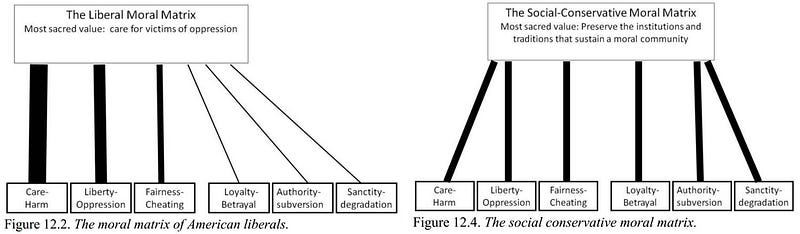
Liberals emphasize three (care, liberty, fairness-as-equality), while conservatives weight all six equally.
My Critique
I question Haidt's conclusion that both political perspectives are equally valid. If morality evolved for survival, shouldn't more adaptive frameworks be superior? Societies becoming increasingly WEIRD (Western, Educated, Industrialized, Rich, Democratic) may favor specific moral foundations over others.
Tarek Amr, March 30, 2018