The Beauty of A.I. Is That It Lives in the Twilight Zone Between Atoms and Bits
Mental models shape the way we think and how we see the world around us. One particularly insightful framework contrasts the World of Bits with the World of Atoms, an idea popularized by Peter Thiel.
In this dichotomy, the world of bits is mostly the world of software. It is where most of the innovations happen. While the world of atoms is everything else. And it is lagging behind in innovations.
“The trend for the last 40 years has been that the world of bits is where the future has been happening.” — Peter Thiel
Think of how much your smartphone has evolved in the last decade compared to your car, the airplane you travel with, or the medicines you take when sick.
It is clear that one world is progressing way quicker than the other, but why is that?
Why did the world of bits become the natural habitat of innovation?
This framework argues that regulations slow innovations down. It also posits that it is easier to innovate in a field that is deterministic.
Regulation
“The reality is regulation often lags behind innovation.” — Bill Maris
You don’t need anyone’s permission to run an experiment to pick the right color of your website’s signup button, but you need all the permissions to run an experiment to pick the right medicine for a disease.
I can go on and on with examples proving that the world of bits is mostly unregulated while the world of atoms is mostly regulated.
Determinism
“The good news about computers is that they do what you tell them to do. The bad news is that they do what you tell them to do.” — Ted Nelson
When you write a piece of software, you can be 100% sure that the computer will perform a certain action when a certain input is given to it. Conversely, when hanging a billboard for your product, you cannot be sure that two people seeing your ad will perform the same action.
Again, it is clear that the world of bits is mostly deterministic, while the world of atoms is mostly stochastic or probabilistic.
So where does A.I. live?
A.I. looks like it belongs to the world of bits because it’s software.
But it behaves like the world of atoms because it’s probabilistic and people demand regulation.
A.I. lives in the space between the two.
A Tale of Two Worlds: Before the Internet
Before the internet, the two worlds were quite separate.
Think of a company creating an accounting software suite in the '80s. They would create it, and put it on disks. Then their salesforce would take it to the physical stores and convince the store owners to make room for it on their shelves. The salespeople were the glue that linked the world of bits and the world of atoms together.
Take another example, a medical device that measures one's heart rate or blood pressure. Back then, you could only get these measures via your doctor. Doctors were trained to use these devices and the software on them. They could deal with its suboptimal UX and interpret the results before conveying them to the patients. The doctors were also the glue that linked the world of bits and the world of atoms together.
The world of bits and the world of atoms were quite separate. The software packages didn’t need to deal with the nuances of their users. Software packages didn’t need to change themselves to appeal to different buyers. They rarely needed to change themselves to appeal to different users. Software packages didn’t need to market themselves, they couldn’t even collect data from their users to learn from and improve.
A Tale of Two Worlds: After the Internet
After the internet, the boundaries between the two worlds were blurred.
The internet had two effects: (i) it changed the software distribution system and their business models (ii) it facilitated data collection.
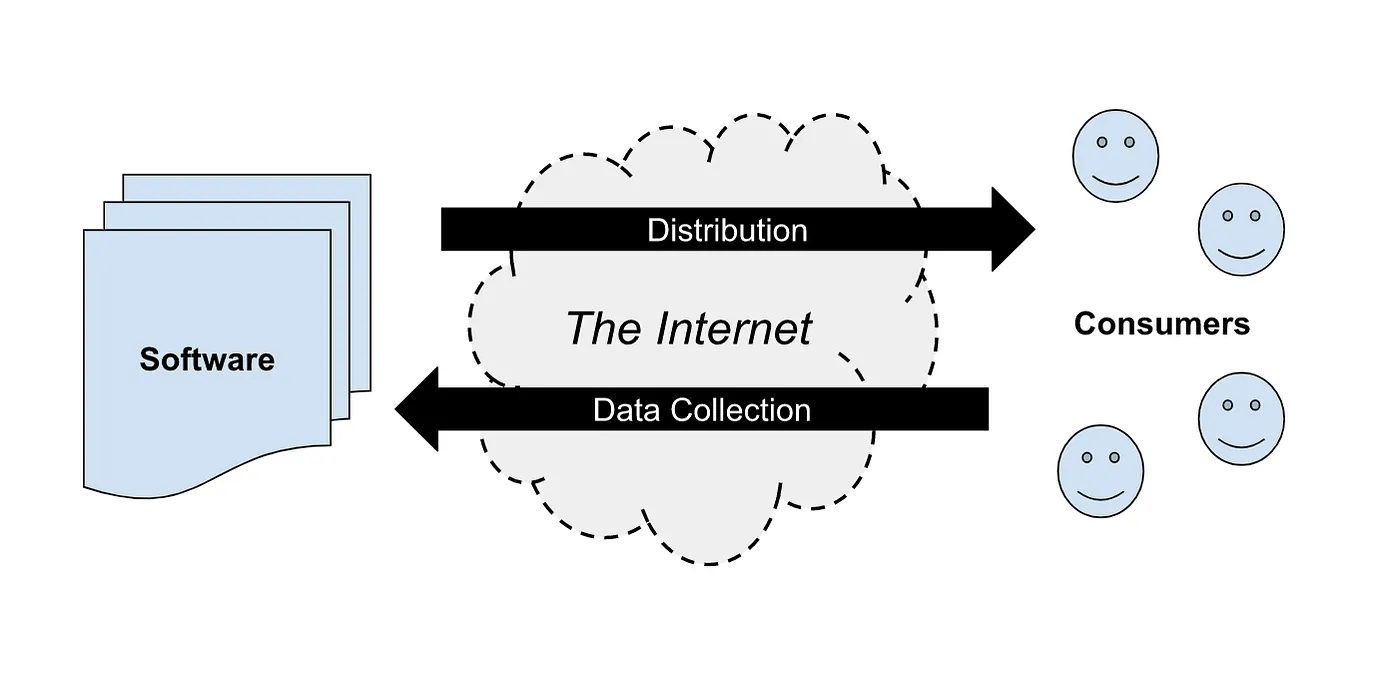
The new distribution model meant that software makers could automate the distribution process. Accounting software today will most likely live on the cloud and is marketed via Facebook or Google ads. Both the software producers and the advertising platform use A.I. to scale and optimize this process.
Being on the cloud opened the door for new business models, such as freemium. Since the software maker has it on their premises, they can easily give it for a limited period for free, then charge for it. And since they don’t sell separate versions, they can opt for a subscription model. This meant that the software had to sell itself. It needs to collect its usage data, learn from it, and adapt to make the users stick forever. Once more, A.I. plays a key role here, or how else can we make optimal use of the user’s data!?
For example, the slightest details of the software such as its signup button, can change over time based on the collected data to increase the users' conversion rate.
The software producers also need to continuously support their products, but they need to keep their costs at bay. Once more, A.I. is needed to automate parts of the support process. It is also needed to make the software intuitive to minimize the need for support.
When it comes to wearables, they are now used by laypeople. The new users, unlike the medical personnel, have no clue how to correctly interpret their heart rate readings. Thus, the new breed of connected devices shouldn’t only worry about the correctness of their readings but also about how interpretable they are. They don’t want to get sued because someone misunderstood what they just saw on their screen. And again, A.I. in combination with the data they collect, is needed to make them 10x easier, better, and cheaper compared to their '80s equivalents.
The twilight zone
A.I. is definitely software, but it also plays a role previously played by humans. And humans are for sure not as deterministic as the software they deal with. And that’s why A.I. is primed to play this role since it combines the characteristics of the two worlds.
Now the probabilistic nature of humans, as well as that of A.I., is scary. If the software is deterministic, one can make sure it is built to follow the rules. And by the way, rules are deterministic by nature, which makes it easy to encode them in code. But when it comes to A.I., everyone has a say now on how to regulate it to mitigate the uncertainty it brings.
But a probabilistic nature doesn't seem to hinder innovation
Back to Peter Thiel’s analysis. A.I. seems to be advancing, even at a higher rate than software, regardless of its probabilistic nature. Thus, I do not think this analysis is correct here. Being deterministic or not doesn’t seem to affect innovation much.
But when it comes to regulation, clearly, A.I.’s potential is not fully realized. Self-driving cars still live in the labs, and precision medicine is not a thing yet. And more examples can make one wonder if A.I.'s applications are still limited due to regulations or if the analysis is wrong here too, and A.I.'s applications are destined to be ubiquitous despite it being regulated.
Tarek Amr